


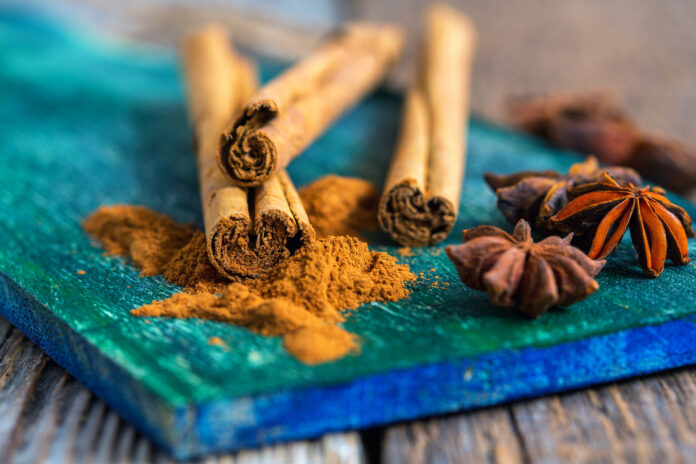
Cinnamon’s potential and benefits exceed its frequent and usual role as a sticky filler in spiraled pastry or an eggnog topping. Experiments indicate that the spice native to Asia might be useful in fighting cancer and Alzheimer’s disease, and in a randomized trial, young women taking cinnamon experienced less menstrual pain and bleeding.
But before deciding to add it to your oatmeal or toast, it’s important to know that cinnamon can interact with certain medications for cardiovascular diseases and diabetes. You should always consult with a physician before altering your diet.
And while research and trials show cinnamon and its extracts might have promise as medical interventions, Western physicians don’t recommend it as a treatment. Additionally, not all cinnamon is created equal. Cinnamon contains a potentially toxic chemical, and the research that shows its potential in fighting debilitating disease has never been conducted in humans.
Nevertheless, cinnamon has a prominent role in Ayurveda, a system of medicine indigenous to India that operates from the premise that keeping the environment, mind, spirit and body in harmony is essential for good health.
In Ayurvedic medicine, practitioners administer cinnamon oil to alleviate sore gums, joint pain, toothaches and rheumatism, according to research on the uses for the spice compiled by Andhra University in India.
Jennifer Aniston incorporates cinnamon in her shake, in her coffee, and in her breakfast smoothie.
If consuming cinnamon that frequently, it’s best to use Ceylon cinnamon. It’s the one that’s less toxic. There are four varieties of cinnamon – Ceylon, which comes from the cinnamomum verum tree, and cassia, korintje and Saigon cinnamons, which all come from different species of the cassia tree.
Ceylon is mild, citrusy and pricey. With its light, honey color and thin, multi-layered brittle quills, commonly referred to as sticks, it’s considered “true cinnamon.”
Ceylon comes from Sri Lanka and southern India, and it has very little coumarin, a toxic chemical found in all varieties of cinnamon, which can cause liver damage if consumed in excess. Ceylon has 250 times less coumarin than cassia.
Common cassia cinnamon comes from Southeast Asia, primarily China and Indonesia, but also Vietnam. It’s sweeter, more robust, and usually what most people in the United States use. Cassia sticks are dark brown and hard, usually with only one coil and lacking the fine, thin layers visible in Ceylon quills.

Saigon and korintje cinnamons are known for their bold and spicier profiles. The former originates from northern and central Vietnam and has a high concentration of cinnamaldehyde. Research has shown that the extract cinnamaldehyde exhibits therapeutic effects as an antioxidant, anti-inflammatory and antibacterial.
Korintje, from Indonesia, has an intense aroma and flavor that make it a favorite among bakers.
Cinnamon Extract and Alzheimer’s Disease
The brains of individuals with Alzheimer’s disease have two distinct hallmarks. Very simply stated, they have plaques and tangles. The plaques are gummy clumps of protein on the outside of nerve cells.
The tangles hinder communication between neurons in the brain. Neurons receive, interpret and dispatch signals that tell muscles, glands or other neurons to form thoughts or control functions and movement. Tangles are aberrant, sticky masses of a protein called tau.
And in experiments involving tangles and tau, cinnamon extract emerged as an element that shows some effectiveness and warrants further investigation.
Researchers from the University of California at Santa Barbara and the Beltsville Nutrition Center in Maryland noted in 2009 that agents that can prevent tau formation might be a pathway to developing new treatments for Alzheimer’s Disease.
Their experiments showed that Ceylon cinnamon extract “can effectively inhibit the formation of tau fibers” in brain cells of rats in a test tube. That team also exposed existing tau tangles from the brains of deceased Alzheimer’s patients to the extract.
The cinnamon solution caused “major disruption” to the fibers that “became disorganized and exhibited a frayed appearance, suggestive of a partial unwinding or disassembly,” but the tangles never completely unraveled even after extended cinnamon exposure.
That team of investigators noted two significant limitations in their research. First, they did not identify the exact tau species that the cinnamon extract molecules targeted in the tangles. Second, there is a lack of studies, including theirs, to determine if cinnamaldehyde can permeate the blood brain barrier.
However, they asserted that their work established a foundation for animal studies and their results could help guide the development of beneficial compounds. Similarly, since their experiment, subsequent reviews of the medicinal potential of cinnamon in preventing and curing Alzheimer’s disease have proliferated.
Cinnamon Extract and Anti-Cancer Activity
A protein that plays an essential role in helping a fetus develop in the womb and facilitating the body’s healing after an injury or surgery also contributes to the growth of tumors.
It’s called vascular endothelial growth factor, or VEGF, and tumors are capable of producing large amounts of VEGF to make their own blood supply and speed their rapid growth. That self-feeding process is called angiogenesis.
Many approved drugs that hinder angiogenesis engender harmful side effects such as high blood pressure, perforations in the gastrointestinal tract and bleeding.
Consequently, researchers seek dietary interventions that could stymy angiogenesis. A team of seven researchers found the Ceylon cinnamon extract “potently inhibited angiogenesis and tumor growth in mice.”

The discovery came with caveats. The study involved ovarian cancer tumors in mice. And the team noted, “it remains to be determined whether CE (cinnamon extract) could be used to treat or prevent tumors from growing in humans. One of the main concerns is whether cinnamon can circulate in vivo with sufficient concentration to be effective.”
Cinnamon For Menstrual Relief
A randomized trial involving 76 college-aged women eliminated one of the barriers to understanding how, and if, potential medicinal qualities of cinnamon would manifest in humans.
The trial involved assessing relief from menstrual pain and accompanying discomforts including nausea and heavy bleeding. Although measuring pain is subjective, researchers quantifiably assessed the saturation of feminine hygiene products and the number of times a participant vomited.
The double blind trial divided the women into two groups of 38. One group received a starch placebo three times a day, and the other consumed 420 milligrams of cinnamon in a capsule twice a day. Both groups took the capsules during the first three days of their menstrual cycle. The researchers did not specify whether the cinnamon capsule contained a variety of cassia or Ceylon cinnamon.
The results suggested “that cinnamon significantly reduced pain, the amount of menstrual bleeding, nausea and vomiting in female college students.” And the findings were similar to herbal medicine studies on the use of cumin and fennel for menstrual discomfort.

